|

Family Home's |
 |
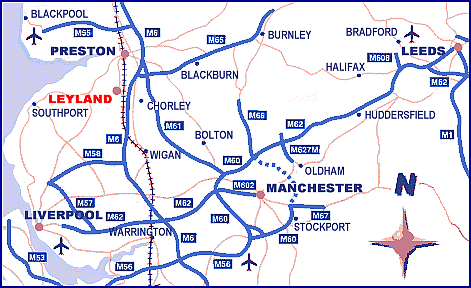
Lancashire ***** The Fylde ***** This Historic area of coastal Lancashire is known to many as he home of Blackpool: the brash, seaside resort that has been entertaining holidaymaker's for generations. To the south lies another resort Lytham St Anne's which is not only somewhat more genteel but also the home of one of the country's most well known golf courses and host to the British Open Championships. b laces e up as a result of expansion of the railway system in the Victorian age when they were popular destinations for the mill workers of Lancashire and Yorkshire. However the Fylde is also an ancient region that was known to both the Saxons and the Romans. To the north of this region around the Wyre estuary the salt marshes have been exploited for over 2,000 years and the process continues at the large ICI plant. Fishing and shipping too have been important sources of revenue here. Fleetwood is still a port though smaller than it was whilst surprisingly thought it might seem today. Lytham was also an important port along the Ribble Estuary. Inland the fertile flat plain has been farmed for many centuries and with few major roads the quiet rural communities lie undisturbed and little changed by the 20th century. A haven for wildlife and particularly birds and plants the two estuaries of the Ribble and the Wyre provide habitats that abound with rare and endangered species of plants and birds. A relatively undiscovered region the Fylde has much more to offer than a white knuckle ride and candy floss and is well worth taking the time to explore. ***** West Lancashire ***** This area of Lancashire with its sandy coastline and flat fertile farmland is home to the elegant Victorian seaside resort of Southport, the ancient market towns of Chorley and Ormskirk and Wigan, another ancient place with a rich industrial past. Following the reorganisation of the county boundaries in the 1970's and the creation of Merseyside much of the coast and the southwestern area of Lancashire became part of the new county but the individual character and charm of this area has certainly not been lost. As well as offering a step back in time the broad promenades of Southport its elegant tree-lined streets and its superb shopping sill makes this one of the most visited towns in the region. Though the silting up of the Ribble estuary to the north has caused the sea at this resort to recede further south at Ainsdale and Formby not only is there paddling but also an vast expanse of sand dune and pine forest that is now an important nature reserve. Behind the coast the flat lands of the West Lancashire plain were once under water. Now with an extensive network of ditches, drainage has provided the old towns and quaint villages with rich fertile land that now produces a wealth of produce all year round and the roadside farm shops are very much a feature of the area. Although there are several rivers flowing across the land the chief water way which is had to miss is the Leeds to Liverpool Canal. Linking the port of Liverpool with industrial Leeds and the many textile villages and towns in between this major navigation changed the lives of many of the people living along its length. However the section through West Lancashire passing rural villages is perhaps one of the more pleasant stretches. There are plenty of charming canal side pubs in the area and walks along the towpath, through the unspoilt countryside have been popular for many years. There is also in this section the wharf at Wigan Pier now a fascinating living museum that brings the canal to life. Chorley ***** East Lancashire ***** This area of the county to the north of Manchester and west of the Pennines is perhaps everyone's idea of Lancashire. A region dominated by cotton East Lancashire has risen and fallen with the fluctuations in the trade over the years but behind the dark satanic mills is a population full of humour and wit as well as some splendid countryside. Before the Industrial Revolution this was a sparsely populated region of remote hillside farms and cottages that relied chiefly on sheep farming and the wool trade. Many of the settlements date back to before the Norman Conquest and though little may have survived the rapid building of the 19th century there are three surprisingly wonderful ancient houses to be seen here: Smithills Hall and Hall-i'-th-wood at Bolton and Turton Tower just to the north. However there is no escaping the textile industry, Lancashire's ideal climate for cotton spinning and weaving - damp so that the yarn does not break - made i the obvious choice for the building of the mills. There are numerous valleys with fast flowing rivers and streams and then the development of the extensive coalfields around Wigan supplied the fuel to feed the power hungry machinery. Finally there was a plentiful supply of labour as families moved from the hill top sheep farms into the expanding towns and villages to work the looms and turn the wheels of industry. In a very short time, smoke and soot filled the air and the once clear streams and rivers became lifeless valleys of polluted squalor. There are many illustrations in the region of the harsh working conditions the labourers had to endure and the dirt and filth that covered much of the area. However, now that much of this has been cleaned up, the rivers running once again fast, clear, and supporting wildlife, the lasting legacy of those days is the splendid Victorian architecture of which every town has at least one example. ****** The Forests of Pendle and Rossendale ***** Although during medieval times both the Forest of Pendle and the Forest of Rossendale were royal hunting grounds these both relatively treeless areas have since hunting ceased developed along very different lines. Pendle with the famous hill at its centre is sill an isolated stretch of moorland with fe roads traversing the scene. Surrounding the higher ground are a series of untouched villages which though they saw some industrialisation with the expansion of the textile industry have still remained small. To the southwest of Pendle Hill lies Whalley a picturesque village save for the giant railway viaduct that is home to one of the best preserved abbeys in the county. The southern edge of the Pendle area is centred around the valley of Colne Water and here are the famous textile towns of Burnley, Nelson and Colne. Further south the larger area the Forest of Rossendale saw the establishment of no real settlements until the 1400's when the Crown leased off parts of the forest and the early 1500's when the final clearance and deforestation began. During the course of the 18th century important advances in textile technology brought the introduction of water powered mills to Rossendale. At this time cotton was also being imported and took over from the traditional woolen cloth manufacture. During the second half of the 19th century the industrial prosperity was so great that Rossendale came known as the Golden Valley. With Blackburn one of the area's oldest settlements in the north and Rawtenstall, Darwen and Bacup in the centre of what was the forest the whole region was a hive of activity, both making and finishing the cloth with others providing the necessary support. However Rossendale though provided with a much better road system still offers tremendous opportunities for outdoor leisure and recreation as well, of course, as a fascinating industrial history.
|
|
|
|
|
||