|
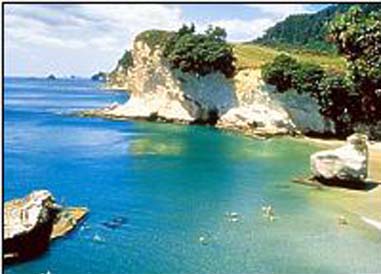
 Cooks Beach, Cathedral Cove |
 |
|
Cooks Beach is a 3km crescent of fine golden sand with safe waters.
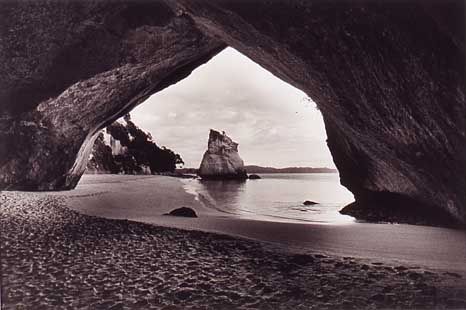
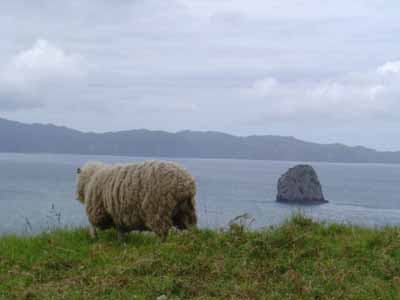
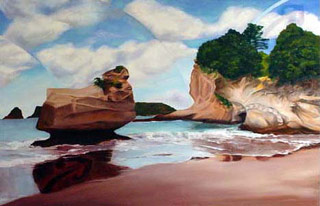
Cathedral Cove Recreational Reserve was donated to the country in 1971 by Vaughan Harsant. With its coastal access it takes up some 34.08 hectares and can be reached either by foot or by boat. This cove lies to the north of Mares Leg Cove (which was washed away during a major storm in 1980) and is accessible (except at high tide) only through the Cathedral, a gigantic arched cavern which penetrates the headland between the two coves. the Cathedral which gives an air of grandeur to the whole of the beach, is about 20 metres wide by about 10 metres high and was formed by sea action. The headland is the site of an ancient Maori pa. The beach is sandy with a pohutukawa backdrop, and provides an ideal picnic spot. Offshore a little way is a large pinnacle of pumice breccia known as 'Te Hoho'. Delicately sculptured by wind and water to form a most impressive and unusual sight, it looks somewhat like the prow of a large ship steaming into the beach. A new viewing platform and information kiosk at Cathedral Cove car park, over-looking Te Whangaui-A-Hei Reserve at Hahei, was officially opened on 12 May 2001. The wheelchair-accessible facility provides magnificent views over the Cathedral Cove-Hahei Beach coastline, while the interpretive information will provide the many thousands of visitors (annually) with an interesting 'snapshot' of the area's history and importance from several perspectives. Long-time Hahei resident and farmer, Vaughan Harsant did the official ribbon-cutting, following a dawn ceremony and blessing by Ngati Hei. Vaughan recounted his memories of early land development and farming in the area - signified by his use of a slasher to cut the ribbon! He recalled how the original round up to near the lookout had been developed by the Crown Lynn pottery company in the 1960's, (they paid him a shilling for the legal right to do so - and he still has it!) when it appeared the Harsant property contained a decent supply of good kaolin (pottery) clay. "Fortunately, the clay wasn't as good as they'd first thought, otherwise this area might look very different today." Vaughan said he then had some enquiries from people wanting to buy land, but he didn't want tot see it sold into little blocks and, through negotiations with the Department of Lands and Survey, eventually gifted some 33 hectares to the nation as recreation reserve.
"Up until the early 1950's, most of the land in this area was very barren because of the inert kaolin clay - it wouldn't even grow a decent gorse bush. Then, aerial top dressing made the land productive for farming." Cathedral
Cove
Cathedral Cove is so named because of the natural rock arch joining it to Mare's Leg Cove. In time, this arch will collapse to form an offshore stack such as Te Hoho Rock at the northern end of Cathedral Cove.
|
|
|
|
|
||